A Tool for Protecting Musculoskeletal Health at Work
In recent years, musculoskeletal disorders (MSDs) have become the most frequent work-related health problem in Europe. According to the European Agency for Safety and Health at Work (EU-OSHA), more than half of all workers experience pain or discomfort related to MSDs at some point during their working lives.
And it is not just about physical discomfort. MSDs affect emotional wellbeing, performance, productivity and, of course, have a significant economic impact on companies and healthcare systems.
Table of Contents
Why are MSDs on the rise?
The Agency highlights several key factors that are influencing this problem:
- An ageing workforce.
- The rise of employment in the service sector.
- Digitalisation and sedentary work at a computer.
- New work models with high levels of pressure and multitasking.
- Prolonged static postures and repetitive movements.
What can the Alexander Technique offer?
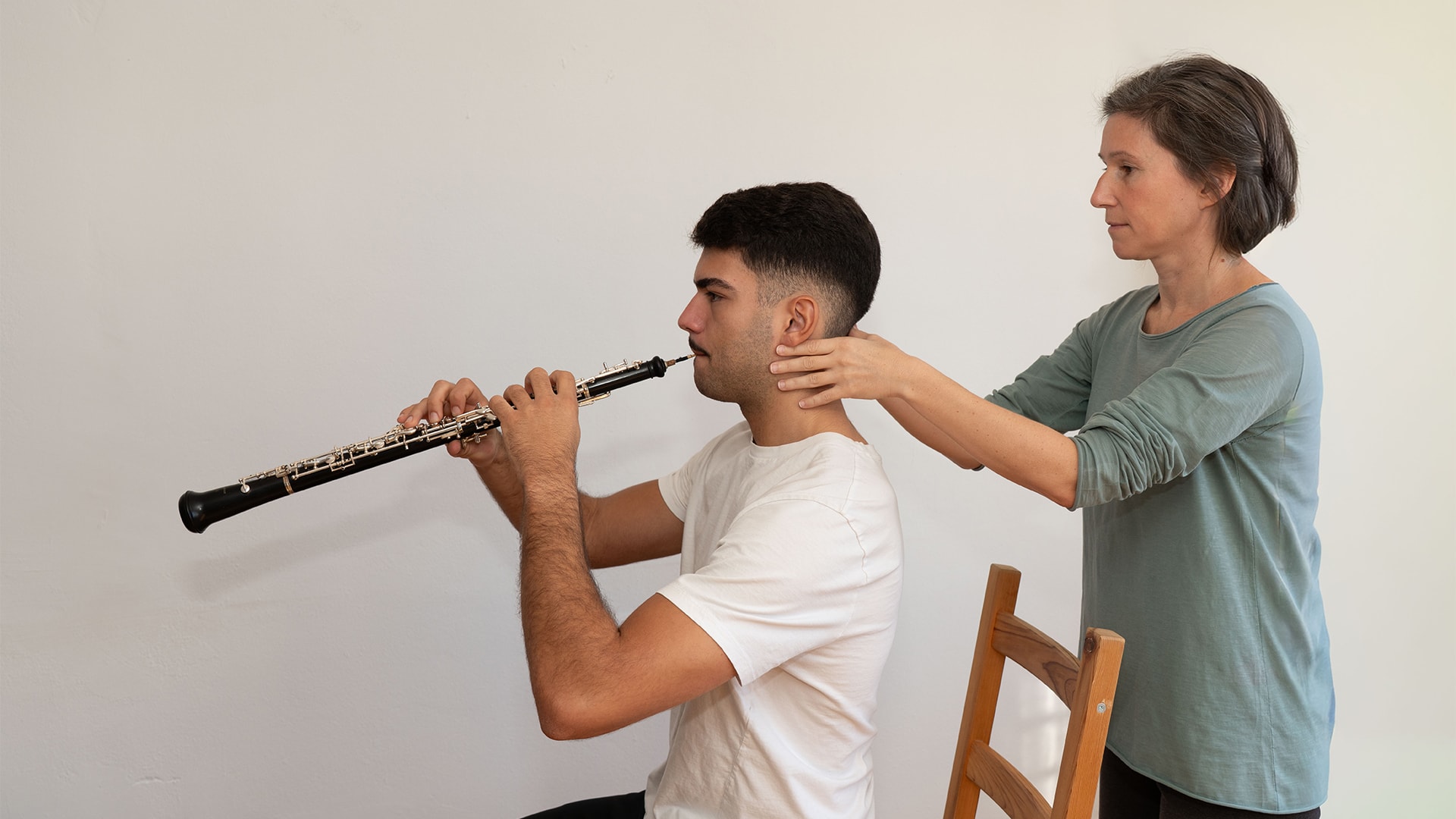
The Alexander Technique is an educational method that helps build awareness of how we use our bodies during daily activities: when sitting, walking, speaking, playing an instrument, or carrying out our work. Rather than teaching “correct posture”, the Alexander Technique helps us to:
- Recognise unconscious patterns of tension.
- Restore more natural and efficient body coordination.
- Reduce effort and muscular load.
- Improve self-management of physical wellbeing in daily life.
It is not about strengthening or stretching, but about learning to move with less tension and more freedom.
What the scientific evidence says
| Observed Benefit | Evidence |
| Pain reduction of up to 86% | Stallibrass (2002), Little (2008) |
| Decrease in functional limitations | Woodman and Moore (2012) |
| Improvement in balance, tone and coordination | Cacciatore (2005, 2010), Shafarman (2010) |
| Better ergonomics for surgeons during operations | Reddy (2011) |
| Improved quality of life and chronic pain management | McClean and Wye (2012) |
| Increased self-confidence and emotional self-regulation | Stallibrass (2002) |
Real-world experiences in companies
A number of companies and organisations have already incorporated the Alexander Technique as part of their occupational health programmes. For example:
- Siemens AG (Switzerland)
- Chevron-Texaco (United States)
- D.E.V.K. Insurance Company (Germany)
- Cincinnati Children’s Hospital
At the Swiss company Victorinox, where there is a heavy manual workload, the Alexander Technique was even integrated as part of the organisational culture. According to their head of production:
“The Alexander Technique became a primary tool for the prevention of musculoskeletal problems. If the employees learn it, it works.”
Who is it for?
- People who spend long hours working while seated.
- Professionals involved in repetitive movements or static postures.
- Workers with a high emotional workload or stress.
- Professions that require presence and communication.
- Artists and athletes looking to improve their performance.
Conclusion
MSDs are not just a physical problem, but an emotional one too. The Alexander Technique offers a practical and educational way to address them, helping people improve their physical wellbeing at work and in their daily lives.
It is not a quick fix, but rather a conscious learning process with lasting, profound benefits that are easily integrated into the working routine.